

Your sleep apnea options
Custom Oral Appliance vs. Sleep Implants
Understanding Your Options for Sleep Apnea
Sleep apnea affects millions of people and can impact health, energy, and quality of life. From surgical implants to custom oral appliances, there are different ways to manage the condition.
Compare your choices
Different Paths to Treating Sleep Apnea
Sleep implants and oral appliances approach the condition in very different ways. Understanding how each works can help you decide which path feels right for you.

Custom Oral Appliances
A removable mouthpiece that gently repositions the jaw or tongue to prevent airway collapse
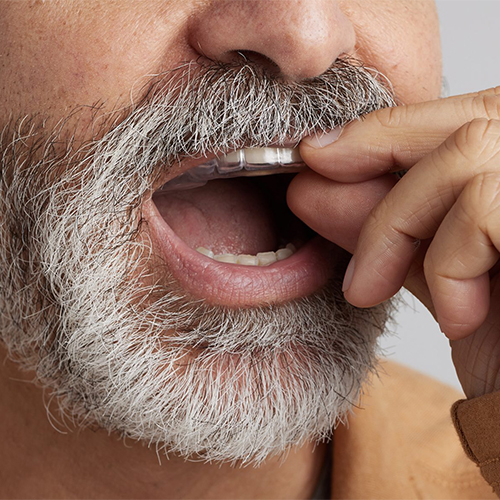
A custom oral appliance is a small device that fits in the mouth, similar to a retainer. It gently repositions the jaw or tongue to keep the airway open during sleep. This option does not require surgery and can usually be fitted and ready to use within a few weeks.

Sleep Implants
A surgically placed device that stimulates airway muscles to keep breathing passages open
Sleep implants require a surgical procedure to place a small device inside the body. The device is connected to a nerve that helps control the airway and is turned on each night with a remote.
Treatment considerations
Does Sleep Apnea Require Surgery?
Not every case of Sleep Apnea requires a surgical intervention and no treatment is right for every patient. The most important thing is to have a conversation with your provider(s) and making sure you understand the full range of treatment options, their advantages, costs, and side effects, and how they apply to the severity of your individual condition.
Costs and timelines
How the Two Treatments Stack Up
| Custom Oral Appliance | Sleep Implants | |
|---|---|---|
| Follow-ups | Occasional quick adjustments | Regular check-ins to program and monitor the implant |
| Timeline to start | Ready in weeks (impressions → fitting) | Months (consults → surgery → activation) |
| Other notes | Non-surgical and reversible | Surgery involved; possible future revisions |
Swipe to see more table information
Are sleep implants the only alternative to CPAP?
No. While sleep implants are one option for people who cannot tolerate CPAP, custom oral appliances provide a non-surgical way to manage sleep apnea. Both work differently, and not every patient is a candidate for implant surgery.
What is recovery like after sleep implant surgery?
Sleep implant procedures require anesthesia and small incisions, followed by a recovery period before the device can be activated. Patients often need several weeks to heal and then return for follow-up visits to fine-tune the device.
How do custom oral appliances compare to implant devices?
Oral appliances are removable and work by gently repositioning the jaw or tongue to keep the airway open. Implant devices, by contrast, use electrical stimulation of airway muscles through a surgically placed device. Many patients prefer the simplicity of an oral appliance.
Are sleep implants covered by insurance?
Insurance coverage for sleep implants depends on your medical plan and typically requires pre-authorization. Custom oral appliances are often covered as well, sometimes under medical and sometimes under dental benefits. Checking coverage ahead of time is important for both options.
Who is a candidate for a custom oral appliance instead of surgery?
Many patients with mild to moderate obstructive sleep apnea, or those who cannot tolerate CPAP, may be good candidates for an oral appliance. This option avoids surgery and provides a more straightforward way to begin treatment.

Contact us
Call us
Locations
1700 Eagle Harbor Pkwy, Suite 7
Fleming Island, FL 32003
9822 Tapestry Park Circle Unit 104
Jacksonville, FL 32246
Hours
Monday 9am- 4pm
Tuesday 9am- 4pm
Wednesday 10am - 5pm
Thursday 9am- 4pm
Friday By Appointment
Saturday Closed
Sunday Closed